

⚡ Key Takeaways
- The hearing aids reviewed and ranked across price, AI sound processing, Auracast support, and clinical fitting access, based on the technology unveiled at the AAA 2026 conference in San Antonio.
- Premium prescription picks: Oticon Intent, Phonak Audéo Sphere Infinio, Starkey Edge AI / Omega AI, ReSound Nexia, and Widex Allure for clinical-grade performance.
- Discreet in-the-ear winner: Oticon Zeal, the first ITE device with Auracast and AI sound processing.
- OTC and value picks: Sennheiser All Day Clear, Lexie B2 Powered by Bose, Audien, Elehear, LINNER, MDHearing, and ZipHearing for hybrid online and clinical fitting.
- Auracast, the Bluetooth LE Audio broadcast standard, is the single biggest 2026 connectivity shift, replacing telecoil in many public venues.
What AAA 2026 Signaled About the Future of Hearing Care
At the American Academy of Audiology’s annual convention in San Antonio (April 22 to 25, 2026), the major hearing aid manufacturers laid out the direction of the industry for the next two to three years. The Future Forecast panel, hosted by the Hearing Industries Association, brought together the presidents of Sonova, Demant North America, ReSound US, WSAudiology, Starkey, and Cochlear America. Three signals came out of that conversation, and they shape the buying decision today.
The first is Auracast. Bluetooth LE Audio is now the connectivity layer almost every premium hearing aid is built on, and Auracast is the broadcast feature that matters. It replaces the telecoil for accessing audio in airports, theaters, churches, lecture halls, and any public venue that installs a transmitter. Cross-brand TV streamers already work between Oticon, ReSound, and Starkey accessories, which is a meaningful change from the proprietary ecosystems of past years.
The second is AI sound processing. Deep Neural Network (DNN) chips are now the core of premium hearing aids from Oticon (DNN 2.0 on the Sirius platform), Starkey (G3 neuroprocessor with DNN360), Phonak (the Sphere Infinio platform), and Signia. The clinical claim is consistent across manufacturers: better speech-in-noise performance compared to the prior generation. The honest read is that AI processing has moved from a marketing line to the actual differentiator between premium and mid-tier devices.
The third, raised on the panel by ReSound’s US president Mikkel Knudsen, is backward compatibility. Many users still rely on telecoil-equipped venues and devices, and the manufacturers committed to maintaining that support during the transition to Auracast. Translation: there is no rush to abandon a working hearing aid, and a buyer choosing now should look for a device that does both.
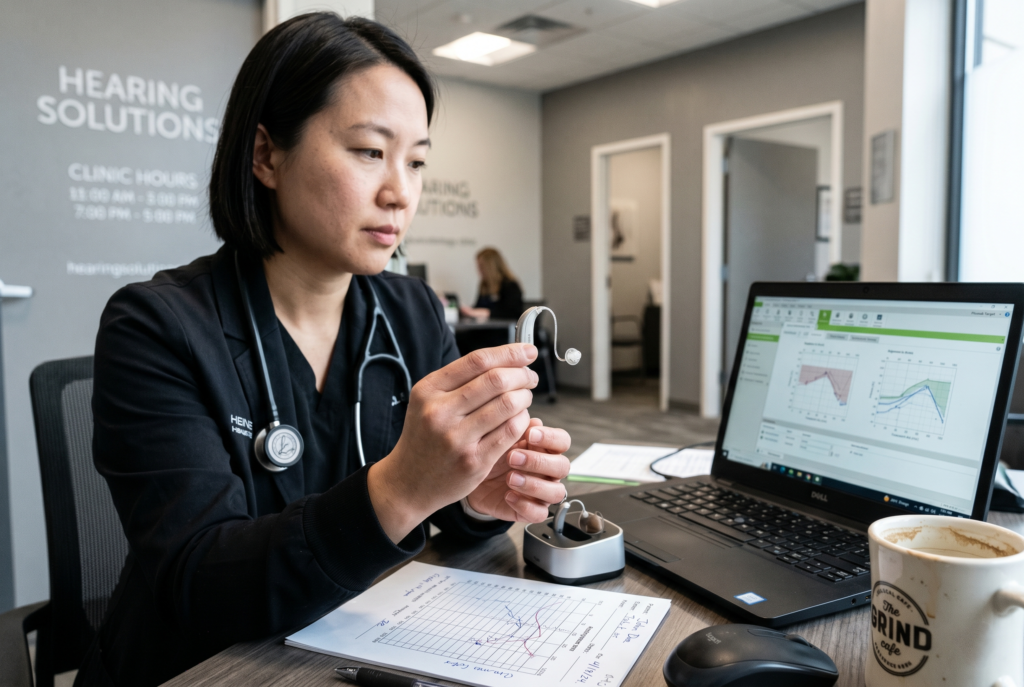
A clinical hearing aid fitting in progress, with the audiologist reviewing the patient’s audiogram alongside Phonak Target fitting software before programming the device.
How These Rankings Were Built
Hearing aids are ranked on five criteria, weighted equally: sound quality and AI processing in noisy environments, connectivity (Auracast and Bluetooth LE Audio), fit and discretion, battery life and rechargeability, and support model and price-to-value. Brands are grouped into three tiers because the right device depends on whether you need a clinical fitting, want a hybrid model, or are a self-fitter. Paid placement influences visibility on BestGuide, never scores or rankings.
The recommendations below pull from the brands BestGuide already evaluates individually. Compare them side by side in the full hearing aids buyer’s guide for individual brand reviews and pricing detail.
Best Premium Prescription Hearing Aids
Premium prescription devices are fitted by an audiologist using your audiogram and Real Ear Measurement verification. They cost more, but they handle severe hearing loss, complex audiograms, and noisy environments in ways no OTC device currently matches.
1. Oticon Intent — Strongest Overall AI Performance
Oticon’s Intent runs on the Sirius platform with a second-generation Deep Neural Network and 4D sensor technology. The DNN 2.0 was trained on millions of real-world sound scenes, which translates into measurable improvements in speech intelligibility in noise. Bluetooth LE Audio and Auracast are built in, with up to 24 hours of battery life on a single charge. Best for: adults with moderate to severe sensorineural hearing loss who want the strongest current AI sound processing.
2. Phonak Audéo Sphere Infinio — Built for Severe Speech-in-Noise Difficulty
Phonak’s Sphere platform uses a dedicated AI chip for speech enhancement and received a firmware update at the end of 2025 that improved battery efficiency by roughly 30%. Bluetooth 5.3 connectivity makes it Auracast-ready (firmware-dependent activation), and AutoSense OS auto-classifies listening environments. Best for: users who spend most of their day in restaurants, classrooms, or other crowded settings where speech tracking is the hardest problem.
3. Starkey Edge AI / Omega AI — Strongest Mobile App and Health Tracking
Starkey’s G3 neuroprocessor uses Deep Neural Networks for both noise reduction and directional control (DNN360). The Omega AI is offered in receiver-in-canal and rechargeable in-the-ear styles, with both disposable battery and rechargeable options. The My Starkey app integrates Auracast Assistant, Google Fast Pair, fall detection, language translation, and step tracking. Starkey’s new shell resin is roughly 20 times stronger than traditional acrylic, addressing a common complaint about damage from drops. Best for: active users who want a tightly integrated app experience and durability.
4. ReSound Nexia — Strongest Cross-Brand Streaming
ReSound’s Nexia line was one of the first premium platforms shipped with Bluetooth LE Audio and Auracast support. ReSound has been notably open about cross-brand accessory compatibility, with TV streamers that work across Oticon and Starkey ecosystems. Best for: households where multiple family members use different hearing aid brands and shared TV streaming matters.
5. Widex Allure — Most Natural Sound Profile
Widex hearing aids are known for low distortion and a natural sound signature, which often appeals to musicians and users who prioritize tonal accuracy over aggressive noise reduction. The Allure platform is LE Audio compatible and Auracast-ready pending firmware activation, with hands-free calling for iPhone and compatible Android devices. Best for: users sensitive to processed-sounding audio.
Discreet In-the-Ear Pick: Oticon Zeal
The Oticon Zeal, formally launched at AAA 2026 in San Antonio, is the standout new product of the year. It is the first in-the-ear hearing aid that combines AI sound processing on the Sirius platform, Bluetooth LE Audio with Auracast, Google Fast Pair, and a lithium-ion rechargeable battery in an invisible custom-fit shell. Oticon’s encapsulation manufacturing process, where the components are built first and the shell is formed around them, allowed the engineering team to shrink the device while keeping IP68 moisture and debris resistance.
For decades, choosing an invisible hearing aid meant accepting limitations: no Bluetooth, no rechargeable battery, basic sound processing. The Zeal is the first ITE device that does not force that compromise. The launch price positions it at the upper end of the prescription market, and it requires a clinical fitting like other prescription devices.
Compare Brands
See Every Hearing Aid Brand Reviewed and Ranked
Side-by-side comparison of premium, hybrid, and OTC hearing aids, with pricing notes, fit options, and support models for each brand.
OTC and Value Hearing Aids
OTC hearing aids are sold without a prescription under the FDA rule that took effect in October 2022. They are intended for adults 18 and older with perceived mild to moderate hearing loss, and the price-performance ratio has improved substantially since the category opened.
Sennheiser All Day Clear — Strongest Sound Quality at the OTC Price Point
Sennheiser’s OTC line is built by Sonova, the parent company of Phonak and Unitron. That means the underlying sound processing is medical-grade, paired with Sennheiser’s audio engineering for natural tonal balance. The free Sennheiser Hearing app handles initial setup and daily tuning. Best for: adults transitioning from consumer earbuds to a true hearing aid without entering the clinical fitting process.
Lexie B2 Powered by Bose — Most Structured Self-Fitting Experience
Bose stopped manufacturing hearing aids and licensed its self-fitting technology to Lexie. The B2 inherits Bose’s tuning algorithms in a Lexie-built device, with strong app-based personalization and accessible pricing. Best for: first-time users who want a structured at-home fitting flow.
Audien — Lowest Entry Price with App Personalization
Audien sits at the most accessible end of the OTC market, with rechargeable BTE and ITE models priced well below the typical $500 OTC threshold. The newer Atom Pro and Ion lines pair with the Audien Hearing Hub app for volume, program, and noise-reduction adjustments. Buyers can shop the current Audien lineup direct from the brand. For a deeper look at fit, sound processing limits, and after-sales support before deciding, our Audien Hearing review walks through what the price gets you and where it stops short. Best for: first-time amplification users who need basic, rechargeable devices for one-on-one and quiet-room conversations.
Elehear — Bluetooth Streaming at OTC Pricing
Elehear focuses on adding Bluetooth phone-call streaming and app-based fine-tuning to the OTC tier, where most sub-$500 devices still lack direct connectivity. The Beyond and Alpha models support hands-free calls on compatible phones and offer self-administered hearing tests in-app. Readers comparing direct-to-consumer Bluetooth options can check Elehear’s current models and pricing, and the BestGuide Elehear review covers app reliability, noise-handling limits, and warranty terms. Best for: mild-to-moderate-loss users who want phone streaming without paying clinical-tier prices.
LINNER — OTC Value with Tinnitus Masking
LINNER’s OTC line covers RIC, BTE, and ITE form factors and stands out at this price tier for including tinnitus-masking sound therapy on select models. Battery life on the rechargeable models runs roughly 18 to 20 hours per charge depending on streaming use. Buyers can browse LINNER’s current OTC lineup direct from the brand, and the BestGuide LINNER review goes through which model fits which use case. Best for: users with mild-to-moderate loss who also experience tinnitus and want a built-in masking option.
MDHearing — Strongest Budget Rechargeable
MDHearing’s NEO, VOLT, and AIR models are FDA-registered OTC devices designed for simplicity and rechargeable convenience. The brand is one of the longest-running direct-to-consumer hearing aid sellers and has stronger customer support infrastructure than most ultra-budget competitors. Best for: adults on a strict budget who need basic amplification for one-on-one conversations and TV.
ZipHearing — Best Hybrid Online and Clinical Model
ZipHearing is not a manufacturer. It is a discount network that connects buyers to local audiologists for in-person fitting of premium prescription brands like Phonak, Oticon, ReSound, Widex, Starkey, and Signia, at negotiated prices. The model includes a 45-day trial, three-year warranty, and one year of follow-up clinic visits. Best for: users with severe hearing loss who want premium brand devices but want to avoid full clinic markup.
Side-by-Side Comparison
| Brand / Model | Category | Auracast | Best For |
|---|---|---|---|
| Oticon Intent | Premium prescription RIC | Yes | Strongest AI sound processing |
| Phonak Sphere Infinio | Premium prescription RIC | Ready | Speech-in-noise heavy users |
| Starkey Edge AI / Omega AI | Premium prescription RIC / ITE | Yes | App integration, durability, health tracking |
| ReSound Nexia | Premium prescription RIC | Yes | Cross-brand streaming compatibility |
| Widex Allure | Premium prescription RIC | Ready | Natural sound, low distortion |
| Oticon Zeal | Premium prescription ITE (invisible) | Yes | Discretion without compromise |
| Sennheiser All Day Clear | OTC RIC | No | Strongest sound at OTC price |
| Lexie B2 (Bose tech) | OTC RIC | No | Self-fitting first-time users |
| Audien | OTC entry-level | No | Lowest entry price, app personalization |
| Elehear | OTC RIC / BTE | No | Bluetooth phone streaming at OTC price |
| LINNER | OTC RIC / BTE / ITE | No | OTC value with tinnitus masking |
| MDHearing | OTC budget | No | Strict budget, basic amplification |
| ZipHearing | Hybrid online + clinic network | Per device | Premium brands, lower clinic markup |
Cost, Insurance, and Coverage
The U.S. Food and Drug Administration estimates the average cost of a single prescription hearing aid at roughly $2,000, putting a pair near $4,000 to $5,000 in many clinics. OTC devices range from about $200 to $1,200 per pair depending on features.
Original Medicare does not cover hearing aids, and the Medicare Hearing Aid Coverage Act (H.R. 500) has not become law. Medicare Advantage plans generally do offer hearing benefits, but coverage caps and provider networks vary widely. For full detail on what each path covers and the legislative status of H.R. 500, see the BestGuide explainer on Medicare hearing aid coverage.
Veterans receive hearing aids through VA audiology, often at no cost, and the AAA 2026 conference highlighted the Oticon Government Services portfolio available on the VA contract. Veterans whose claims have been denied or under-rated can find help through a VA-accredited disability attorney handling hearing loss and tinnitus claims.
Who Should Buy What
If you have severe hearing loss, frequent noisy environments, or a complex audiogram: a premium prescription device fitted by an audiologist using Real Ear Measurement is the right path. Within that tier, the choice between Oticon Intent, Phonak Sphere Infinio, Starkey Edge AI / Omega AI, ReSound Nexia, and Widex Allure depends on which feature you weight most. Strongest AI processing favors Oticon. Toughest speech-in-noise problem favors Phonak. Tightest app integration favors Starkey. Cross-brand streaming favors ReSound. Most natural sound profile favors Widex.
If discretion is the deciding factor and your hearing loss is moderate: the Oticon Zeal is the first ITE device that does not force a compromise. Pair it with an audiologist who follows Real Ear Measurement verification.
If you have mild to moderate hearing loss and want to avoid the clinical pathway: Sennheiser All Day Clear, Lexie B2 Powered by Bose, Audien, Elehear, LINNER, or MDHearing all deliver real value at OTC prices. Sennheiser leads on sound, Lexie leads on fitting flow, Audien leads on lowest entry price, Elehear leads on Bluetooth phone streaming, LINNER leads on tinnitus masking, and MDHearing leads on rechargeable simplicity at the lowest budget tier.
If you want premium prescription technology at lower clinic prices: ZipHearing’s hybrid model is the most cost-effective hybrid path. You get the same Big Six brands fit by a local audiologist, with a 45-day trial and three-year warranty included.
Frequently Asked Questions
What are the leading hearing aids overall?
For premium prescription, the Oticon Intent leads on AI sound processing, Phonak Audéo Sphere Infinio leads on speech-in-noise, Starkey Edge AI and Omega AI lead on app integration and durability, ReSound Nexia leads on cross-brand streaming, and Widex Allure leads on natural sound. For OTC, Sennheiser All Day Clear leads on sound quality at the price point, while Audien, Elehear, LINNER, and MDHearing dominate the entry-level rechargeable tier.
What is Auracast and why does it matter for hearing aids?
Auracast is a Bluetooth LE Audio broadcast feature that allows public venues, TVs, and other audio sources to stream directly to hearing aids and earbuds within roughly 300 feet. It is replacing telecoil in many venues and removes the need for proprietary streaming accessories. Most current premium hearing aids are either Auracast-enabled or Auracast-ready pending firmware activation.
Is the Oticon Zeal worth the price?
The Zeal is the first in-the-ear hearing aid with full Bluetooth LE Audio, Auracast, AI sound processing, and lithium-ion rechargeable battery in an invisible form factor. For users who prioritize discretion and previously had to compromise on connectivity or rechargeability, the Zeal closes that gap. For users without a strong discretion preference, a receiver-in-canal device like the Oticon Intent offers similar processing in a slightly more visible form.
Are OTC hearing aids as good as prescription hearing aids?
OTC hearing aids are designed for adults 18 and older with perceived mild to moderate hearing loss. They use lower output limits than prescription devices (111 dB SPL, or 117 dB SPL with input-controlled compression, under the FDA rule). For mild to moderate loss, OTC devices like Sennheiser All Day Clear, Lexie B2, Audien, Elehear, and LINNER perform well in quiet and moderately noisy environments. Severe hearing loss, complex audiograms, and frequent challenging listening environments still favor prescription devices fitted clinically.
How much do hearing aids cost?
The FDA estimates the average cost of a single prescription hearing aid at roughly $2,000, putting a pair near $4,000 to $5,000 in many clinics. OTC hearing aids range from about $200 to $1,200 per pair, with brands like Audien, MDHearing, and LINNER pushing the lower end below $500. Hybrid models like ZipHearing offer premium prescription brands at discounted prices through a network of local audiologists.
Does Medicare pay for hearing aids?
Original Medicare does not cover hearing aids or routine fittings. Medicare Advantage plans almost always include hearing benefits, but coverage caps and provider networks vary by plan. The Medicare Hearing Aid Coverage Act (H.R. 500) was introduced in January 2025 but has not become law. See the BestGuide explainer on Medicare hearing aid coverage for full detail.
Can veterans get hearing aids through the VA?
Yes. The Department of Veterans Affairs covers hearing aids for eligible veterans, often at no cost, through the VA audiology contract. Major manufacturers including Oticon, Phonak, ReSound, Starkey, and Widex are on the VA contract. Veterans with service-connected hearing loss or tinnitus generally qualify; veterans whose claims were denied or under-rated can pursue an appeal with a VA-accredited attorney.
What’s the difference between Bluetooth LE Audio and classic Bluetooth on hearing aids?
Bluetooth LE Audio uses the LC3 codec for higher-quality audio at lower power consumption, which extends battery life during streaming. It also supports Auracast broadcast, multiple simultaneous connections, and improved pairing. Classic Bluetooth (5.0 and earlier) on older hearing aids works for direct phone streaming but does not support Auracast broadcasts.
Should I buy hearing aids online or from a local clinic?
Severe hearing loss, complex audiograms, and first-time users with no clinical baseline benefit from a local audiologist who can perform Real Ear Measurement verification. Mild to moderate hearing loss in adults comfortable with self-fitting can be served well by OTC devices online. Hybrid models like ZipHearing combine online ordering with local fitting, which suits users who want premium brands without paying full clinic markup.
How long do hearing aids last?
Most hearing aids last five to seven years with regular care. Rechargeable lithium-ion batteries typically need replacement after three to five years of daily use. Software and firmware updates can extend the useful life of the underlying device, especially as Auracast and other Bluetooth LE Audio features roll out by firmware update on Auracast-ready models.
 Audicus
.png) Ceretone Hearing Aids
Ceretone Hearing Aids Eargo
Eargo Jabra Enhance
 Lexie
Lexie MDHearing